 Ptah
Test the Data Your Migration Must Preserve
Catch a migration that silently loses a price, test the corrected SQL and rollback, and share native Ptah test reports without a vendor account.

Ptah helps you plan, review, and apply database migrations. Try in your browser
The migration completed. The order’s price became zero.
Our example adds an integer cents column to an existing orders table. The first attempt creates the column with a default of zero but forgets to copy the old price. Every SQL statement succeeds. A test that inserts an order before the change catches the mistake immediately:
FAIL step "(unnamed step)" — expected scalar "1995", got "0"This is a real failed assertion from Ptah 0.13.0, run against its disposable SQLite test database. The corrected migration, rollback test, schema test, and HTML reports are in the example files.
Run the following commands from a writable copy of that example directory.
Put an existing order through the change
Section titled “Put an existing order through the change”Our version 1 table stores an amount. Version 2 introduces amount_cents.
The test describes what must survive the transition:
cases: - name: price survives migration and rollback steps: - migrate_to: 1 - exec: INSERT INTO orders (id, amount) VALUES (1, 19.95) - migrate_to: latest - assert: {query: "SELECT amount_cents FROM orders WHERE id = 1", scalar: "1995"} - migrate_to: 1 - assert: {query: "SELECT amount FROM orders WHERE id = 1", scalar: "19.95"}Ptah migrates to version 1, inserts the fixture, and applies the remaining
migrations. It then reads the new column. The assertion expects 1995 cents
for the existing 19.95 order. After that, it migrates back and checks that
the original amount is still present.
The broken/ directory contains the version that omits the data copy. Run it
with the same test:
ptah migrations test --dir tests --migrations-dir broken=== MIGRATION TEST ===FAIL case "price survives migration and rollback" PASS step "(unnamed step)" — migrated to 1 PASS step "(unnamed step)" — exec ok PASS step "(unnamed step)" — migrated to latest FAIL step "(unnamed step)" — expected scalar "1995", got "0"
1 cases, 0 passed, 1 failed, 0 skippedThe command exits 1. Notice that the migration steps passed before the assertion failed. This is a data requirement that SQL execution alone did not establish. The migration linter examples cover complementary checks on the change itself.
Fix the migration, keep the assertion
Section titled “Fix the migration, keep the assertion”The corrected up migration adds the missing conversion:
ALTER TABLE orders ADD COLUMN amount_cents integer NOT NULL DEFAULT 0;UPDATE orders SET amount_cents = CAST(ROUND(amount * 100) AS INTEGER);ptah migrations test --dir tests --migrations-dir migrations=== MIGRATION TEST ===PASS case "price survives migration and rollback" PASS step "(unnamed step)" — migrated to 1 PASS step "(unnamed step)" — exec ok PASS step "(unnamed step)" — migrated to latest PASS step "(unnamed step)" — scalar "1995" PASS step "(unnamed step)" — migrated to 1 PASS step "(unnamed step)" — scalar "19.95"
1 cases, 1 passed, 0 failed, 0 skippedThis run exits 0. It checks both the forward value and the value after rollback. The old amount column remains in this example, so rollback can remove the new column without reconstructing the old price.
The fixture tests one positive price. It does not establish a complete currency conversion policy: rounding boundaries, negative amounts, overflow, and currencies with different minor units need their own cases. Write those requirements before accepting a migration for real orders.
Test a schema without a migration history
Section titled “Test a schema without a migration history”A schema test starts from a declared schema. Here the cents column has a
CHECK (amount_cents >= 0) constraint. We insert a valid order, count it,
and require the negative insert to fail:
cases: - name: prices must be nonnegative steps: - exec: INSERT INTO orders (id, amount_cents) VALUES (1, 1995) - assert: {query: SELECT count(*) FROM orders, scalar: "1"} - assert: {query: "INSERT INTO orders (id, amount_cents) VALUES (2, -1)", error_contains: "CHECK constraint failed"}ptah schema test --dir schema-tests --schema-file schema.sql=== SCHEMA TEST ===PASS case "prices must be nonnegative" PASS step "(unnamed step)" — exec ok PASS step "(unnamed step)" — scalar "1" CAUGHT step "(unnamed step)" — error contained "CHECK constraint failed"
1 cases, 1 passed, 0 failed, 0 skippedCAUGHT means the database returned the error that the test expected. An
unexpected successful insert would fail that assertion. The two commands
exercise different starting points: migration tests traverse history;
schema tests exercise the declared end state. The
testing documentation
describes both formats.
Open the result in a browser
Section titled “Open the result in a browser”Add --report html to retain the native report:
ptah migrations test --dir tests --migrations-dir broken --report html > failed-report.htmlptah migrations test --dir tests --migrations-dir migrations --report html > passed-report.htmlThe failing test still exits 1 while writing the report. In CI, retain the file as an artifact even when the test job fails.
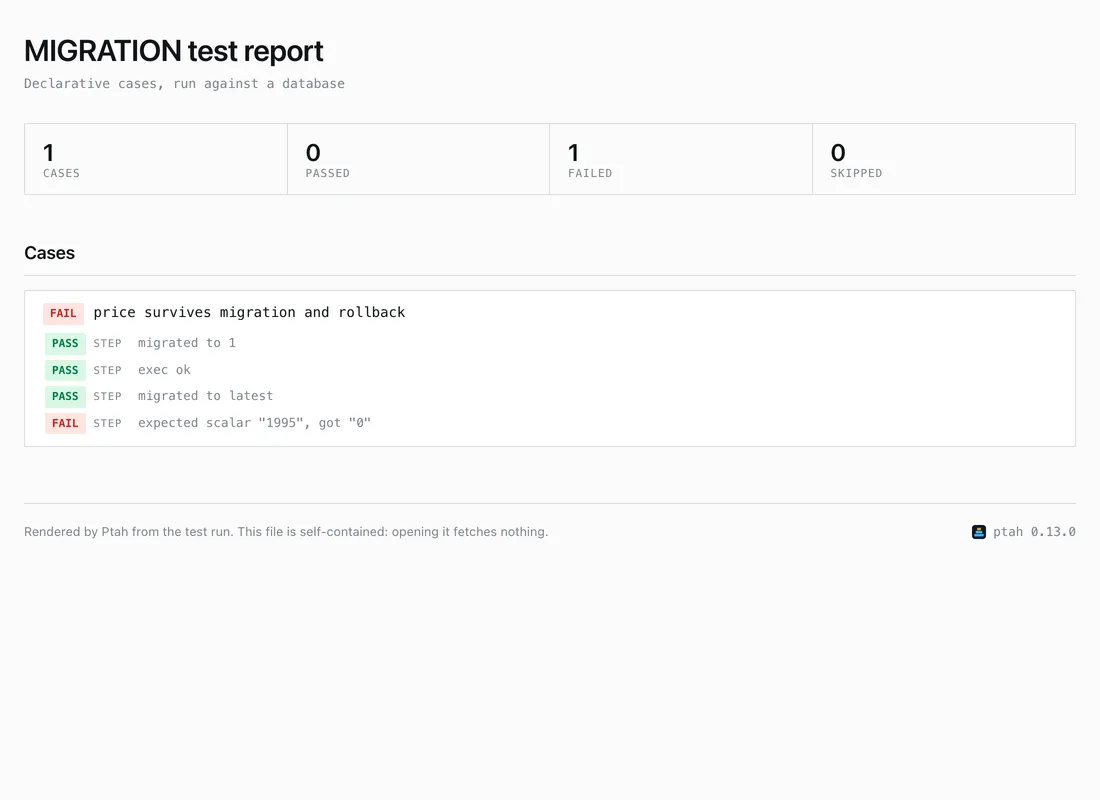
Open the failed report and compare it with the passing report. These are Ptah’s generated files. We opened both in light and dark browser themes; those checks made no external requests. The report carries the assertion result, so a reviewer can see the failure without replaying a terminal recording.
Keep testing in your own toolchain
Section titled “Keep testing in your own toolchain”These test commands are part of Ptah’s MIT-licensed open-source CLI. They ran without an account or paid subscription. With no database URL, this example uses the runner’s temporary SQLite database.
Atlas documents migration and schema testing as Pro features available to
free and paid users, with atlas login required. That is the distinction
to evaluate; Pro does not automatically mean payment is required. See its
migration testing and
schema testing documentation, checked on
October 8, 2026. The comparison describes Atlas’s documented requirements.
If you want this workflow in an open-source CLI that you can operate without a vendor account, follow From Atlas to Ptah. It walks through retaining migration history and verifying the next change. Keep the data test beside the migration so the same assertion runs in local development and CI.
Put Ptah to work
Example files
- broken/0000000001_orders.down.sql
- broken/0000000001_orders.up.sql
- broken/0000000002_cents.down.sql
- broken/0000000002_cents.up.sql
- build-provenance.json
- failed-report.html
- images/failed-report-dark@2x.png
- images/failed-report-light@2x.png
- images/passed-report-dark@2x.png
- images/passed-report-light@2x.png
- measured/broken-test.txt
- measured/browser-checks.txt
- measured/commands.json
- measured/failed-assertion.txt
- measured/failed-html.txt
- measured/failed-report-dark-page.txt
- measured/failed-report-light-page.txt
- measured/license.txt
- measured/passed-html.txt
- measured/passed-report-dark-page.txt
- measured/passed-report-light-page.txt
- measured/passing-test.txt
- measured/schema-test.txt
- measured/version.txt
- migrations/0000000001_orders.down.sql
- migrations/0000000001_orders.up.sql
- migrations/0000000002_cents.down.sql
- migrations/0000000002_cents.up.sql
- passed-report.html
- README.md
- schema-tests/orders.yaml
- schema.sql
- tests/orders.yaml
- verified.json


