 Ptah
Generate OpenMeter's View Migrations Instead of Copying Them
OpenMeter copies generated view SQL into its migrations by hand. Ptah Compat writes those statements and keeps Ent, golang-migrate and schema_om.

Ptah helps you plan, review, and apply database migrations. Try in your browser
OpenMeter defines its tables and
one view, charges_search_v1s, in Ent. Atlas generates the table migrations.
The view is different: the project’s
migration instructions
tell the developer to copy the generated CREATE VIEW from
tools/migrate/views.sql into the new migration, and to add a DROP VIEW
when the definition changes. A parity test catches a wrong copy afterwards.
We ran the same workflow with ptah-compat as the generator. Ent stays the
source of truth. The committed files keep the golang-migrate layout, and
golang-migrate still applies them and records the version in schema_om.
The copy step goes away: ptah-compat migrate diff writes the view
statements itself, in the order PostgreSQL needs.
The study uses OpenMeter commit
f04b561f8,
Ptah 0.16.1 and PostgreSQL 15.19. The
integration patch, scenario changes and records are
beside the article. This is an independent case study. OpenMeter has not
adopted it.
Who writes which SQL
Section titled “Who writes which SQL”Each part of OpenMeter’s schema pipeline writes its own SQL:
| Part | Writes |
|---|---|
Ent schema and tools/migrate/cmd/entschema |
the table SQL Atlas compares with |
viewgen, run by go generate |
tools/migrate/views.sql |
tools/migrate/deferred_constraints.sql |
foreign keys Ent cannot make deferrable |
atlas migrate --env local diff |
timestamped .up.sql and .down.sql files and atlas.sum |
golang-migrate applies the committed files. OpenMeter’s own instructions say Atlas “does not auto-generate view DDL”, so step 4 of every view change is a manual edit of a generated file.
The configuration also needs more than the open-source Atlas build. The
Community edition refuses the exporter data source on this atlas.hcl:
Error: data.external_schema is not supported by the community version of Atlas.Its upgrade notice also lists views among the objects the edition does not
support. OpenMeter’s
CI job
installs the non-Community Atlas binary, version 0.36.0. ptah-compat reads
the same atlas.hcl, runs the exporter as Atlas does, and needs no account.
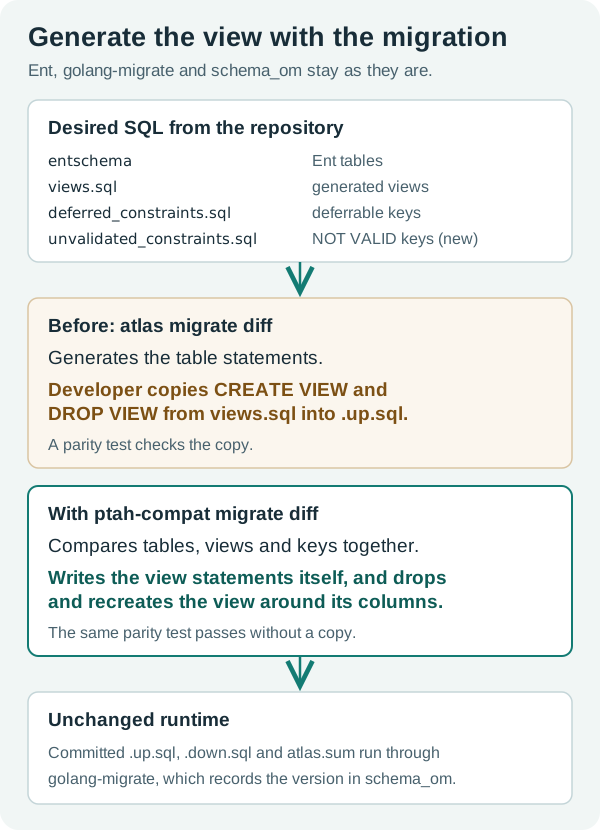
What the integration changes
Section titled “What the integration changes”The integration patch touches
the exporter, atlas.hcl and one new SQL file. The migration history stays as
it is.
The exporter reads the views from views.sql. Ent’s own view DDL lists the
columns of charges_search_v1s in a different order from the one its SELECT
produces them in. PostgreSQL names a view’s columns by position, so that DDL
would label the id column type. views.sql is the definition OpenMeter
already tests, so the exporter passes it on beside the deferred constraints:
ddl, err := entschema.GenerateSQL(cmd.Context(), entschema.GenerateSQLInput{ SchemaPath: "./openmeter/ent/schema", PostgresVersion: "15", SupplementalDDL: string(views) + "\n" + string(unvalidated) + "\n" + string(constraints), OmitViews: true, })Objects the history owns are excluded from the comparison. Functions, a
trigger, the pgcrypto extension and two kinds of operational tables come from
hand-written migrations, not from Ent. Without an exclusion, the diff would
plan to drop them:
schema_exclude = [ "distributed_locks[type=table]", "om_migration_backup_*[type=table]", "om_func_*[type=function]", "delete_entitlement_on_subscription_item_delete[type=function]", "*.trigger_delete_entitlement_on_subscription_item_delete[type=trigger]", "pgcrypto[type=extension]", ]Ten ledger foreign keys may stay NOT VALID. Migration
20260709134422_add_ledger_internal_fks adds them that way on purpose and says
they are validated “separately after orphan preflight”. Ptah compares
validation state, and Ent has no way to declare it. Without a declaration, the
first diff would validate all ten at once, and a production run with an
orphaned row would fail on it. The new unvalidated_constraints.sql allows
each key to stay NOT VALID, one line per key, the way
deferred_constraints.sql records deferrability:
-- ptah:allow-not-valid CONSTRAINT "ledger_customer_accounts_ledger_accounts_customer_accounts" ON "ledger_customer_accounts"The definition stays Ent’s. A change to the key’s columns or actions is still
planned, and the key comes back NOT VALID. A key validated later satisfies
the line too; removing the line makes Ptah require the key validated again.
The first diff on the unchanged history is empty
Section titled “The first diff on the unchanged history is empty”With the patch applied, we run OpenMeter’s documented command with
ptah-compat in place of atlas:
ptah-compat migrate --env local diff --dev-url "$DEV_URL" baseline_checkPtah replays the 304 committed migrations into the dev database and compares the result with the exporter’s output:
The migration directory is synced with the desired state, no changes to be madeNo file is written. The history, the views it created and the ten unvalidated keys match the desired schema as declared.
The error stream reports each kind of warning in one line:
warning: 3 atlas.hcl settings are ignored for Atlas compatibility and have no effect; PTAH_LOG_LEVEL=debug lists themwarning: 47 names are longer than 63 bytes; the server keeps their first 63 bytes, and they are read that way; PTAH_LOG_LEVEL=debug lists themThe three settings are exclude and non_linear entries the community binary
accepts and ignores too.
Ent writes 40 foreign keys and 7 indexes with names longer than PostgreSQL’s
63-byte limit. The server keeps the first 63 bytes, and so do the history files
Atlas generated. Ptah reads each name the way the server stores it and refuses
two names that would be cut to the same one. No dev database is needed for that
check. PTAH_LOG_LEVEL=debug lists each name as written and as stored.
$DEV_URL points at a dedicated PostgreSQL 15.19 server. The history runs DO
blocks and its own BEGIN, so the run also sets
PTAH_DEV_SERVER_DISPOSABLE=1, which declares that server disposable. It holds
no application data.
Change the view
Section titled “Change the view”The view change adds status_detailed to charges_search_v1s. The developer
edits the Ent view schema and runs go generate, which rewrites views.sql.
The scenario patch
holds the Ent change. Then:
ptah-compat migrate --env local diff --dev-url "$DEV_URL" add_status_detailed_to_charges_searchPtah writes an up file with one statement, CREATE OR REPLACE VIEW, which
appends status_detailed to each branch of the UNION ALL. PostgreSQL accepts
a replace that only adds columns at the end, so the view keeps its grants and
nothing that reads it is dropped. The
down file cannot use a replace, because it
removes a column, so it drops the view and recreates the previous definition:
-- reverse: modify "charges_search_v1s" viewDROP VIEW "charges_search_v1s";-- reverse: modify "charges_search_v1s" viewCREATE VIEW "charges_search_v1s" ASSELECT charge_credit_purchases.id, charge_credit_purchases.namespace,Nobody copied views.sql. golang-migrate applies the new file:
migrate -database "$OPENMETER_URL" -path ./tools/migrate/migrations upThe rows already in the three charge tables appear in the view with the new
column. A second migrate diff reports that the directory is synced.
Change a column the view reads
Section titled “Change a column the view reads”The dependency case changes charge_flat_fees.feature_key from varchar to
varchar(128) in Ent. PostgreSQL refuses to change the type of a column that a
view reads:
ERROR: cannot alter type of a column used by a view or ruleDETAIL: rule _RETURN on view charges_search_v1s depends on column "feature_key"Ptah plans around it. The up file drops the view, changes the column, and
creates the view again from views.sql:
-- drop "charges_search_v1s" viewDROP VIEW "charges_search_v1s";-- modify "charge_flat_fees" tableALTER TABLE "charge_flat_fees" ALTER COLUMN "feature_key" TYPE character varying(128);The down file does the same in reverse. Under the manual workflow, this is the change where a developer has to know about the dependency and order three statements by hand.
The third scenario, a nullable external_reference on tax_codes, is an
ordinary ALTER TABLE ... ADD COLUMN.
Down files, a fresh database and OpenMeter’s tests
Section titled “Down files, a fresh database and OpenMeter’s tests”The records compare each state of the reference database with the catalog after the matching step:
down 1 = after scenario 2: samedown 2 = after scenario 1: sameup again = after scenario 3: samedata after up again = after scenario 3: sameA fresh database built from the whole directory, history and new files, has
the same catalog as the incrementally upgraded one, and ptah-compat schema diff
reports them synced. The ten ledger keys are still NOT VALID at the end.
OpenMeter’s own TestViewDefinitionsMatchGeneratedSchemaSQL,
TestSourceWrapper and TestLegacyEntAdoptionSchemaParity pass on the
extended directory. The view parity test now checks statements Ptah wrote.
OpenMeter’s CI checks pass
Section titled “OpenMeter’s CI checks pass”The “Migration Checks” job in OpenMeter’s CI installs Atlas and runs one
target. We ran it in the golang:1.27.0 image, the Go version OpenMeter’s
.go-version names, with ptah-compat 0.16.1 installed as atlas:
make migrate-checkThe target exits 0. go generate leaves Ent’s code unchanged.
atlas migrate --env local diff starts its own dev database from
docker://postgres/15/dev and writes no file. migrate validate accepts the
atlas.sum checksums.
migrate lint --latest 10 covers the three new files. Two have no findings.
The column change gets a warning, not an error:
-- analyzing version 20261026150332 -- diagnostics detected: -- L4 [PG301]: ALTER COLUMN "charge_flat_fees"."feature_key" TYPE character varying(128) changes the type from character varying to character varying(128), which checks every value against the new limit; PostgreSQL rewrites the whole table and rebuilds every index on it under the ACCESS EXCLUSIVE lock the statement holds, blocking reads and writes until the rewrite finishes, and a stored value the new type cannot hold aborts the statement (value too long for type). A widening PostgreSQL can prove safe is a catalog edit instead: a longer or unlimited varchar, a higher numeric precision at the same scale, a longer fractional-seconds precision. Where the change cannot be expressed that way, add a new column, backfill it in batches, and swap the two -- ok (2.259297ms)The scenario adds a length limit to an unlimited column, so PostgreSQL checks
every value and rewrites charge_flat_fees. On a large production table, that
change needs the rollout the warning describes. The older files in the window
get their own warnings, for example for BEGIN blocks in hand-written
migrations. None of them is an error.
The pull request job also checks that atlas.sum only gains lines. The three
new files append three records, and the check passes against the base commit:
python3 .github/tools/migrate/check_atlas_sum_append_only.py f04b561f8What changes for the next schema change
Section titled “What changes for the next schema change”| Step | With Atlas | With ptah-compat |
|---|---|---|
Edit Ent, run go generate |
yes | yes |
| Generate the migration | atlas migrate --env local diff |
ptah-compat migrate --env local diff |
Copy view SQL into .up.sql, add DROP VIEW |
by hand | not needed |
| Order view drops around column changes | by hand | written by the diff |
| Apply the files | golang-migrate | golang-migrate |
Run make migrate-check in CI |
Atlas 0.36.0 | ptah-compat installed as atlas |
SQL execution stays where it was. golang-migrate runs the committed files and
knows nothing about views. The view becomes declared state at generation time:
Ptah compares the definition in views.sql with the one the replayed history
produced and writes the statements that close the gap.
The new files use comments for each planned change and leave the Atlas-written history intact. Each file applies, and the repeat diff is empty.
Known issues
Section titled “Known issues”- Some migration shapes still differ from Atlas’s generated SQL: stokaro/ptah#4921.
- A view whose
CREATE VIEWhas a column list and aliased select items, as Ent’s own view DDL does, is rendered with two aliases on an item: stokaro/ptah#4933. The integration readsviews.sql, which has no column list.
Start with the examples README to reproduce the run.
Put Ptah to work
Example files
- commands/atlas-sum-check.txt
- commands/first-diff.txt
- commands/migrate-check.txt
- commands/up.txt
- commands/view-diff.txt
- diagrams/workflow.svg
- integration/exclude-excerpt.hcl
- integration/exporter-excerpt.go
- integration/openmeter-ptah.patch.txt
- integration/patched/atlas.hcl
- integration/patched/tools/migrate/cmd/entschema/main.go
- integration/patched/tools/migrate/unvalidated_constraints.sql
- integration/unvalidated-excerpt.sql
- OPENMETER-LICENSE.txt
- README.md
- records/05-ent-export-pristine.sql
- records/05-ent-export-view.sql
- records/06-ent-export-view-apply.txt
- records/06-ent-export-view-rows.txt
- records/10-atlas-community-control-excerpt.txt
- records/10-atlas-community-control.txt
- records/20-first-diff-result.txt
- records/20-first-diff-warnings.txt
- records/20-first-diff.txt
- records/21-first-diff-status.txt
- records/30-ref-history.txt
- records/31-ref-data-before.txt
- records/32-ref-up-unchanged.txt
- records/33-snap-start.txt
- records/41-0-generate-stat.txt
- records/41-1-diff.txt
- records/41-2-20261026145253_add_tax_code_external_reference.down.sql
- records/41-2-20261026145253_add_tax_code_external_reference.up.sql
- records/41-3-repeat.txt
- records/41-4-up.txt
- records/41-5-snap.txt
- records/41-6-data.txt
- records/42-0-generate-stat.txt
- records/42-1-diff.txt
- records/42-2-20261026145811_add_status_detailed_to_charges_search.down.sql
- records/42-2-20261026145811_add_status_detailed_to_charges_search.up.sql
- records/42-2-down-excerpt.sql
- records/42-3-repeat.txt
- records/42-4-up.txt
- records/42-5-snap.txt
- records/42-6-data.txt
- records/42-7-view-rows.txt
- records/43-0-alter-under-view.txt
- records/43-0-generate-stat.txt
- records/43-1-diff.txt
- records/43-2-20261026150332_limit_flat_fee_feature_key.down.sql
- records/43-2-20261026150332_limit_flat_fee_feature_key.up.sql
- records/43-2-up-excerpt.sql
- records/43-3-repeat.txt
- records/43-4-up.txt
- records/43-5-snap.txt
- records/43-6-data.txt
- records/50-down-1.txt
- records/51-snap-after-down-1.txt
- records/52-down-2.txt
- records/53-snap-after-down-2.txt
- records/54-up-again.txt
- records/55-snap-after-up-again.txt
- records/56-data-after-up-again.txt
- records/57-rollback-comparison.txt
- records/60-fresh-up.txt
- records/61-snap-fresh.txt
- records/62-fresh-comparison.txt
- records/63-fresh-vs-incremental-diff.txt
- records/70-openmeter-parity-tests.txt
- records/80-worktree-status.txt
- records/81-change-stat.txt
- records/89-ci-remote-dev-memory-failure.txt
- records/90-ci-lint-scenario-3-excerpt.txt
- records/90-ci-make-migrate-check.txt
- records/90-ci-versions.txt
- records/91-ci-atlas-sum-append-only.txt
- records/versions.txt
- reproduction/seed.sql
- scenarios/s1-tax-code-external-reference.patch.txt
- scenarios/s2-charges-search-status-detailed.patch.txt
- scenarios/s3-limit-flat-fee-feature-key.patch.txt
- verified.json
- verify-records.py
- versions.json
