 Ptah
Go Models and HCL Database Rules in One Ptah Schema
Declare tables with Go annotations, keep a shared PostgreSQL trigger function in HCL, and let Ptah merge both into one schema it diffs and migrates.

Ptah helps you plan, review, and apply database migrations. Try in your browser
A Go service stores account emails in a unique column. Ada@Example.COM and
ada@example.com must be the same account, whether the row comes from the
application, a backfill script, or someone at a psql prompt. The rule that
guarantees this belongs in the database: a trigger that normalizes the email
before the uniqueness check sees it.
The tables already live in Go structs with Ptah annotations. The trigger function is PL/pgSQL, and two tables need it. We’ll keep the application model in Go, put the database rule in an HCL file, and let Ptah treat both as one desired schema: one diff, one migration, one comparison.
This run used Ptah 0.14.0 and PostgreSQL 18.6. The supporting files contain the models, the HCL file, the generated migrations, and every recorded result.
Where a Go annotation ends
Section titled “Where a Go annotation ends”An annotation is a //ptah: comment beside a struct or a field. Ptah reads the
source files with Go’s own parser and never builds or runs the package, so the
Go toolchain does not have to be installed. Our render below ran with no go
on the PATH.
package models
// Invitation is an address an account has invited but that has not signed up// yet, so it is matched against Account.Email when the invitee arrives.////ptah:schema:table name="invitations"type Invitation struct {  //ptah:schema:field name="id" type="BIGINT" primary="true" identity_generation="BY DEFAULT"  ID int64
  //ptah:schema:field name="account_id" type="BIGINT" not_null="true" foreign="accounts(id)" foreign_key_name="invitations_account_fk"  AccountID int64
  //ptah:schema:field name="email" type="TEXT" not_null="true"  Email string}
Annotations can declare functions and triggers too, but every annotation is a
single comment line. A trigger annotation takes its body as one quoted
attribute, and it has no attribute for running a function declared somewhere
else. We tried to point a trigger at normalize_email:
error: error parsing packages: unknown annotation attribute "function" on //ptah:schema:trigger at AccountWith the body written inline instead, Ptah generates a private function for every trigger. Two triggers on one table become two copies of the same body:
CREATE FUNCTION "ptah_trigger_accounts_accounts__normalize__email__on__insert"()CREATE TRIGGER "accounts_normalize_email_on_insert" BEFORE INSERT ON "accounts" FOR EACH ROW EXECUTE FUNCTION "ptah_trigger_accounts_accounts__normalize__email__on__insert"();CREATE FUNCTION "ptah_trigger_accounts_accounts__normalize__email__on__update"()CREATE TRIGGER "accounts_normalize_email_on_update" BEFORE UPDATE ON "accounts" FOR EACH ROW EXECUTE FUNCTION "ptah_trigger_accounts_accounts__normalize__email__on__update"();Four triggers across two tables would mean four copies to keep in step. The tables are a good fit for annotations; the rule is not.
Put the database rule in HCL
Section titled “Put the database rule in HCL”HCL gives the function a multi-line body and lets a trigger name the function it
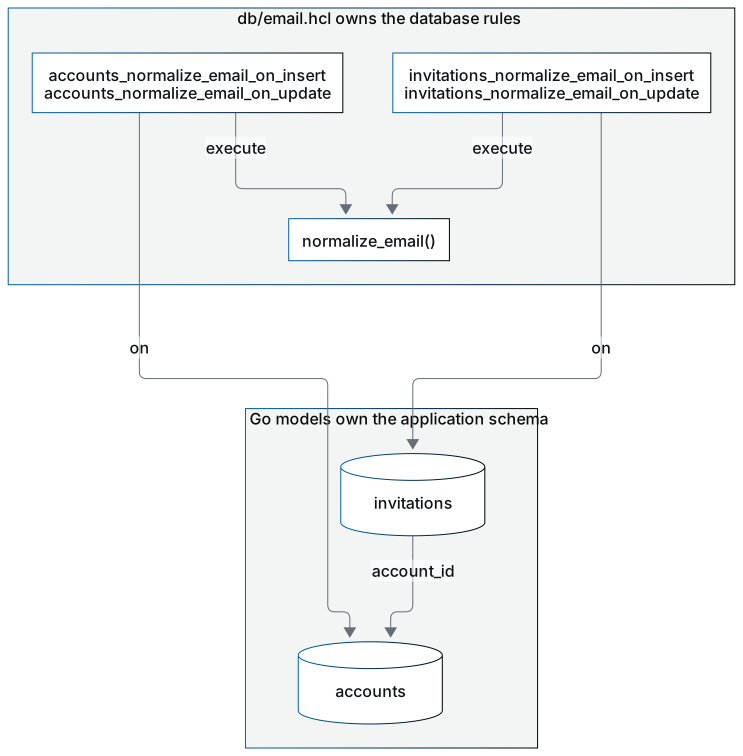
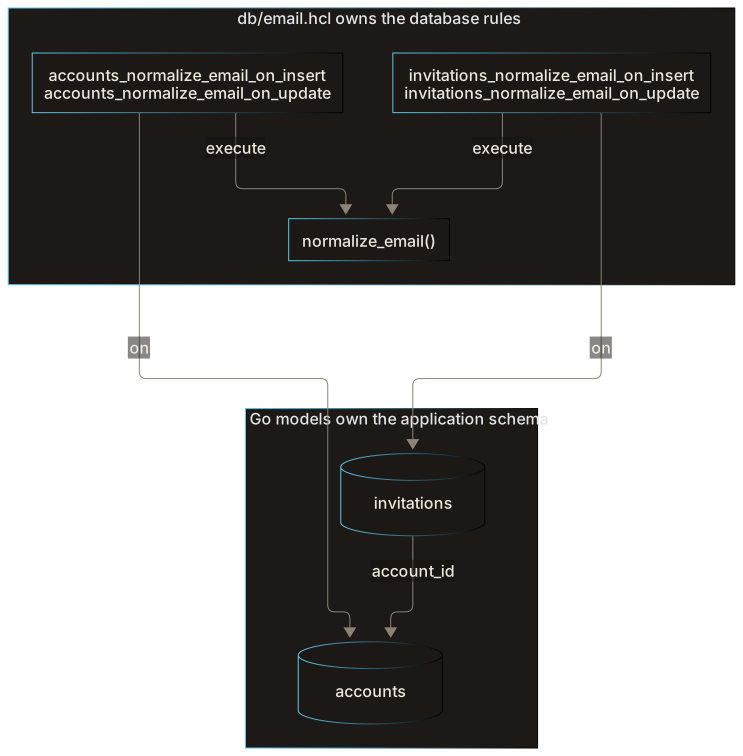
runs. The file declares normalize_email once and four triggers that execute
it, one per table and event. This is the function and the first trigger:
function "normalize_email" {  schema = schema.public  lang   = PLpgSQL  return = trigger  as     = <<-SQL    BEGIN      NEW.email := lower(btrim(NEW.email));      RETURN NEW;    END;  SQL}
trigger "accounts_normalize_email_on_insert" {  on = table.accounts  before {    insert = true  }  for = ROW  execute {    function = function.normalize_email  }}
table.accounts refers to a table the HCL file never declares. It comes from
the Go models. The reference crosses the source boundary without an import or a
stub declaration:
How two sources become one schema
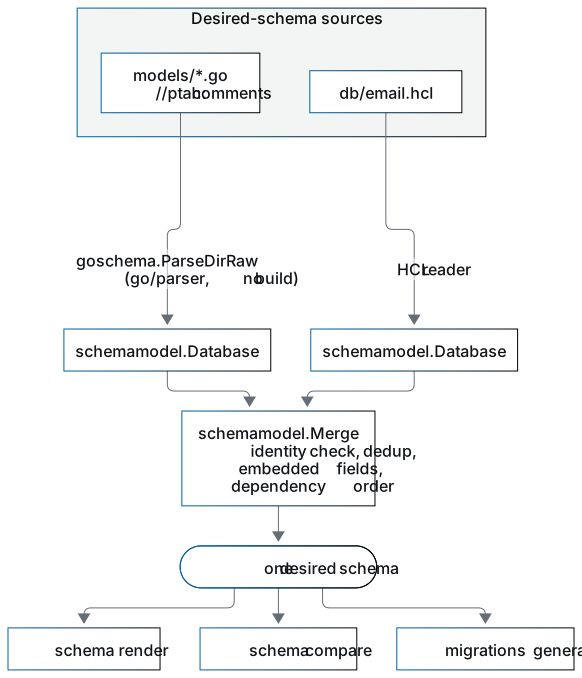
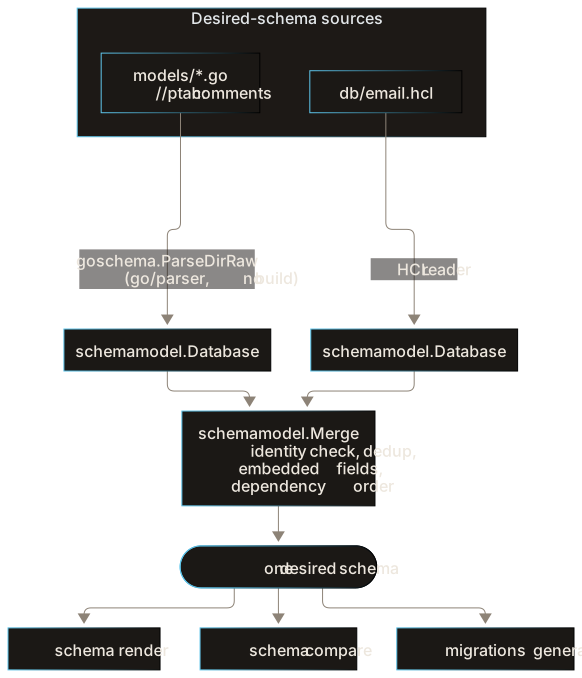
Section titled “How two sources become one schema”Both flags repeat and mix: --root-dir for Go packages, --schema-file for
HCL, YAML, SQL or DBML files. Every reader returns the same Go value, a
schemamodel.Database,
and nothing after the readers can tell which format an object came from.
The model is not a tree of Go types or HCL blocks. It is a set of flat lists:
tables, fields, indexes, constraints, functions, triggers and the rest. A Go
struct becomes one entry in Tables, and each annotated field becomes one
entry in Fields that records its struct in StructName. An HCL function
becomes one entry in Functions. A trigger becomes one entry in Triggers
that names its table and the function it executes as plain strings.
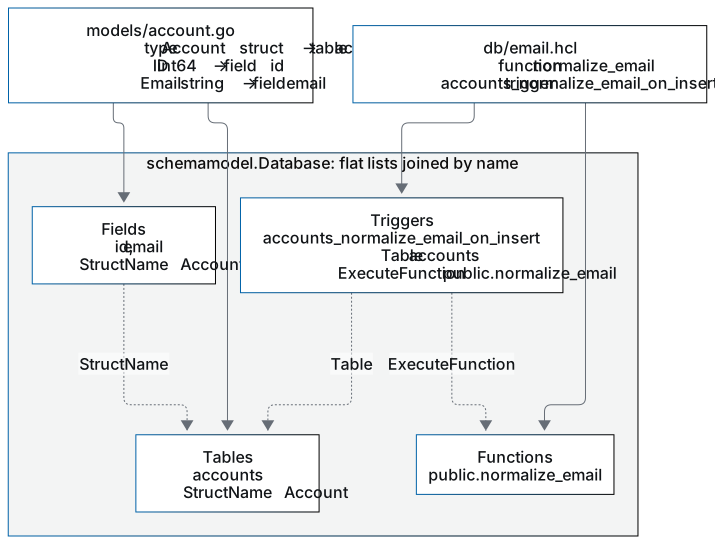
Because references are names, a cross-source reference is not a special case. The merge concatenates every source’s lists. Then it runs the same finalization a single Go root gets:
- Compare every object by its database identity: the schema-qualified name for a table, the table-qualified name for a field, index, constraint or trigger, and the global name for a function or extension. Identical definitions collapse to one. Different definitions with the same identity stop the command.
- Expand embedded Go structs into the fields of the tables that embed them.
- Build the dependency graph from foreign keys, then order tables and functions by their dependencies.
The code is short enough to read in full:
internal/schemaload
parses each Go root without finalizing it (goschema.ParseDirRaw), reads each
schema file, and hands everything to
schemamodel.Merge.
Rendering the merged schema shows the result. The summary counts two tables and five fields, all from Go. The statement order interleaves the two sources by dependency:
ptah schema render --root-dir ./models --schema-file ./db/email.hcl \ --dialect postgresFound 2 tables, 5 fields, 0 indexes, 0 enums, 0 embedded fields
Table Dependencies:==================accounts: (no dependencies)invitations: depends on [accounts]
Table Creation Order:====================1. accounts2. invitationsThe first line of each rendered statement, in order:
CREATE FUNCTION "public"."normalize_email"() RETURNS trigger AS $$CREATE TABLE "accounts"CREATE TABLE "invitations"ALTER TABLE "invitations" ADD CONSTRAINT "invitations_account_fk" FOREIGN KEY ("account_id") REFERENCES "accounts"("id");CREATE TRIGGER "accounts_normalize_email_on_insert" BEFORE INSERT ON "accounts" FOR EACH ROW EXECUTE FUNCTION "public"."normalize_email"();CREATE TRIGGER "accounts_normalize_email_on_update" BEFORE UPDATE ON "accounts" FOR EACH ROW EXECUTE FUNCTION "public"."normalize_email"();CREATE TRIGGER "invitations_normalize_email_on_insert" BEFORE INSERT ON "invitations" FOR EACH ROW EXECUTE FUNCTION "public"."normalize_email"();CREATE TRIGGER "invitations_normalize_email_on_update" BEFORE UPDATE ON "invitations" FOR EACH ROW EXECUTE FUNCTION "public"."normalize_email"();The function comes first, because it needs nothing else. The foreign key follows the two tables it connects, and the triggers come last, after both the tables they attach to and the function they run. The tables came from Go and the rest from HCL; the order does not show it.
Generate, apply, and test the rule
Section titled “Generate, apply, and test the rule”DB_URL points to an empty PostgreSQL database and SHADOW_URL to a separate,
disposable one. The same two flags drive migration generation:
ptah migrations generate --db-url "$DB_URL" \ --root-dir ./models --schema-file ./db/email.hcl \ --migrations-dir migrations --name accounts_and_email_rules \ --shadow-db "$SHADOW_URL"ptah migrations lint --dir migrations --dialect postgres --fail-on errorptah migrations hash --dir migrationsptah migrations up --db-url "$DB_URL" --migrations-dir migrations --verify-sumGeneration passed its shadow apply, rollback and reapply check. Lint exited 0
with one note and five warnings, all worth reading. The note says the function
body is not analyzed: Ptah does not parse PL/pgSQL, so reviewing the rule is
still a person’s job. The warnings are about locks that CREATE TRIGGER and a
new foreign key take. In this migration the tables are created by the same
file, so no other session is writing to them yet.
The application check inserts two accounts and an invitation, then updates the invitation’s email:
INSERT 0 2INSERT 0 1UPDATE 1accounts|1|ada@example.comaccounts|2|grace@example.cominvitations|1|1|linus.t@example.comThe inserted ' Ada@Example.COM ' and the updated 'LINUS.T@EXAMPLE.COM '
were stored normalized. A second account for ADA@example.com is now a
duplicate of the first, and the unique constraint rejects it:
ERROR: duplicate key value violates unique constraint "accounts_email_key"DETAIL: Key (email)=(ada@example.com) already exists.Comparing the live database with the merged desired schema found no differences. The function and all four triggers read back from the catalog exactly as the HCL file declares them.
ptah schema compare --db-url "$DB_URL" \ --root-dir ./models --schema-file ./db/email.hcl \ --schemas public --exit-codeChange the Go side only
Section titled “Change the Go side only”The service needs a display name. The change touches one Go struct:
package models
// Account is a customer login. Its email is unique, so every spelling of one// address has to reach the database in a single canonical form.////ptah:schema:table name="accounts"type Account struct {  //ptah:schema:field name="id" type="BIGINT" primary="true" identity_generation="BY DEFAULT"  ID int64
  //ptah:schema:field name="email" type="TEXT" not_null="true" unique="true"  Email string
  //ptah:schema:field name="display_name" type="TEXT"  DisplayName *string}
Generating against the updated database, with the same two sources, produced a migration with a single statement:
ALTER TABLE "accounts" ADD COLUMN "display_name" TEXT;Nothing from the HCL file was recreated. The desired function and triggers
already matched the database, so they were not part of the diff. After
applying it, the comparison found no differences again, and an update that
set the display name still stored the email normalized. All four triggers
still executed the one normalize_email function.
Give every object one owner
Section titled “Give every object one owner”Composition works when each object has exactly one owner. We added a second
HCL file that also declared accounts, with email as varchar(320) instead
of TEXT, and rendered all three sources. No database is involved:
ptah schema render --root-dir ./models --schema-file ./db/email.hcl \ --schema-file ./conflict/accounts.hcl --dialect postgreserror: error merging composite schema: conflicting table "accounts" definitionsThe command exited 2 and rendered nothing. Ptah does not choose a winner
between two definitions of one object, and it does not treat one source as an
overlay on another. Split ownership by object, not by property: accounts
belongs to Go in full, and normalize_email belongs to HCL in full.
The result is a split that follows the objects. Go annotations describe the tables the application reads and writes, next to the code that uses them. The HCL file holds the database rules that need a real body and more than one table. Ptah merges both into one desired schema, and every command that reads the schema reads the merged one.
Put Ptah to work
Example files
- annotation-only/inline/account.go
- annotation-only/shared/account.go
- before/account.go
- conflict/accounts.hcl
- db/email.hcl
- expected/annotation-inline-body.txt
- expected/annotation-shared-function.txt
- expected/conflict.txt
- expected/display-name.sql
- expected/email-function-and-trigger.hcl
- expected/render-order.txt
- expected/render-summary.txt
- measured/annotation-inline-body.txt
- measured/annotation-shared-function.txt
- measured/application-final.txt
- measured/application.txt
- measured/commands.json
- measured/compare-final.txt
- measured/compare-initial.txt
- measured/conflict.txt
- measured/duplicate.txt
- measured/generate-display-name.txt
- measured/generate-initial.txt
- measured/go-toolchain.txt
- measured/hash-display-name.txt
- measured/hash-initial.txt
- measured/lint-display-name.txt
- measured/lint-initial.txt
- measured/render.txt
- measured/status-final.txt
- measured/up-display-name.txt
- measured/up-initial.txt
- measured/version.txt
- migrations/1792650310_accounts_and_email_rules.down.sql
- migrations/1792650310_accounts_and_email_rules.up.sql
- migrations/1792650328_display_name.down.sql
- migrations/1792650328_display_name.up.sql
- migrations/ptah.sum
- models/account.go
- models/invitation.go
- README.md
- verified.json